Politics of Hypocrisy: When Principles Become Convenient
By Enyinnaya Appolos
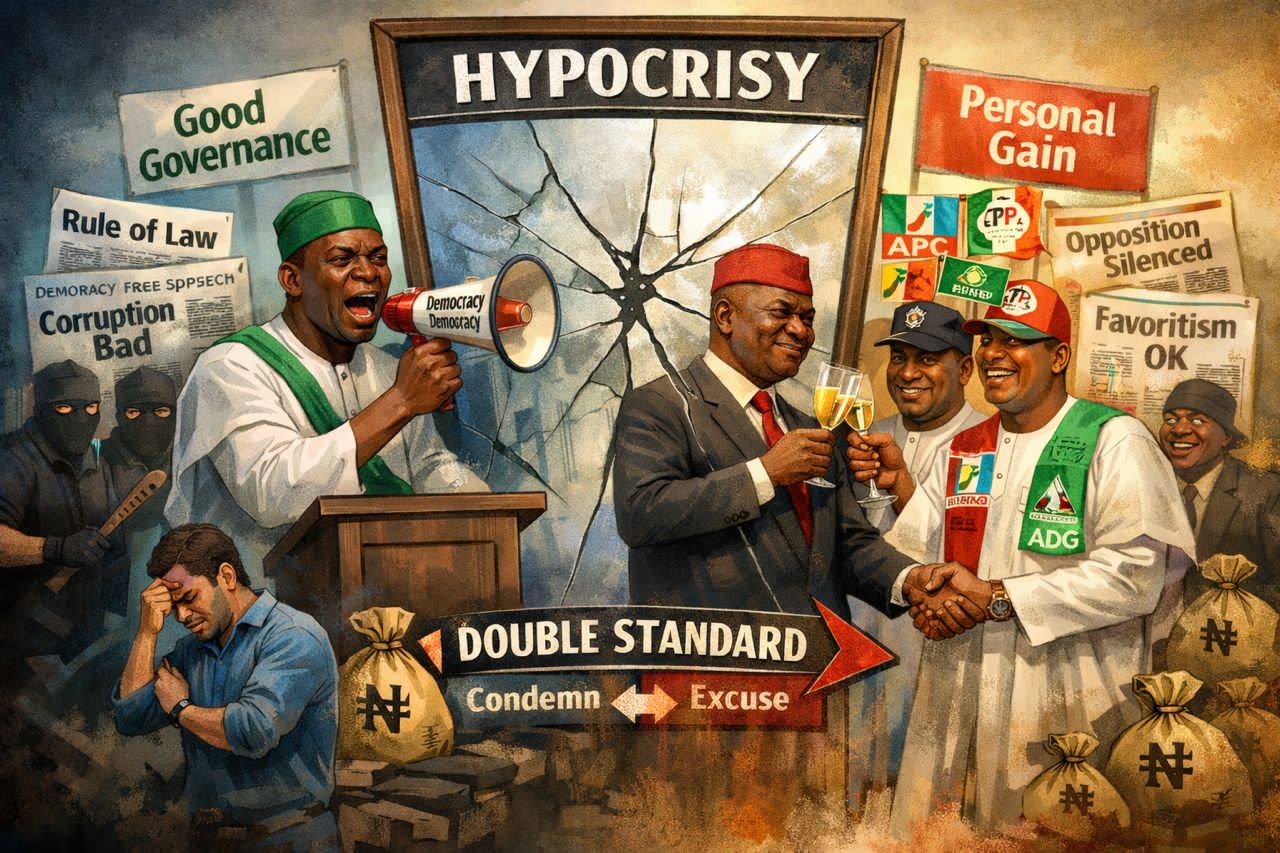
A dangerous trend is tightening its grip on our politics, one driven not by principle, but by raw convenience. It is the audacity to condemn in others what we shamelessly celebrate in ourselves; a brazen culture of double standards where words and actions no longer pretend to align.
That pattern has a name: hypocrisy. Its closest ally is double standards.
Let us bring this home.
Just yesterday, many of those who are now shouting the loudest in defence of Alex Otti were preaching tolerance, inclusion, and fairness. Today, they have reinvented themselves as enforcers of selective morality, applauding actions when it suits their camp, and condemning the same actions when carried out by others.
So, what is hypocrisy?
You support a governor in Abia who has weakened democratic structures, tightening his grip on the state legislature and local government system, yet you demonize others for doing the same. When control becomes “strategic leadership” in your camp, but “authoritarianism” elsewhere, what exactly do you call that?
What is a double standard?
In Abia, supporters of Otti openly intimidate dissenting voices. People are threatened simply for expressing the opinion that Otti will not be re-elected in 2027. Yet, the same actors suddenly become defenders of democracy and free speech when their allies are criticized.
When intimidation is rebranded as “loyalty,” and dissent as “treason,” what do we call it?
Let’s go further.
When Governor Otti and his faction within the Labour Party signal support for the re-election of Bola Ahmed Tinubu in 2027, it is dressed up as “pragmatism” and “strategic alignment.” But when others express similar political choices, they are vilified, insulted, and branded traitors.
Again, what is hypocrisy? What is a double standard?
You cannot claim the right to hold an opinion and, at the same time, deny others that same right. What makes your preference superior to another’s?
The uncomfortable truth is this: for many, politics is not about values, it is about advantage. What benefits them is “good”; what does not is “bad.” Principles are not fixed, they are adjusted to suit interests.
Even more troubling is our collective amnesia.
How do individuals who have held power since 1999, as Speakers, Governors, and Ministers, even Vice President, suddenly re-emerge as saints and anti-corruption crusaders the moment they lose access to power? Where was this moral outrage when they were in office? Why are they now celebrated by the same people whose trust they once exploited?
This is not accountability. It is selective outrage.
A society that normalizes hypocrisy loses its moral compass. A political culture built on double standards cannot sustain justice, fairness, or progress. When truth becomes relative and principles become transactional, democracy itself is weakened.
Nigeria cannot move forward on the foundation of convenience-driven morality.
The real question is not just for our leaders, but for all of us:
Do we truly believe in the values we preach, or are we merely loyal to interests disguised as principles?
Until we confront this culture of hypocrisy, we will keep recycling the same failures, only with different faces.